
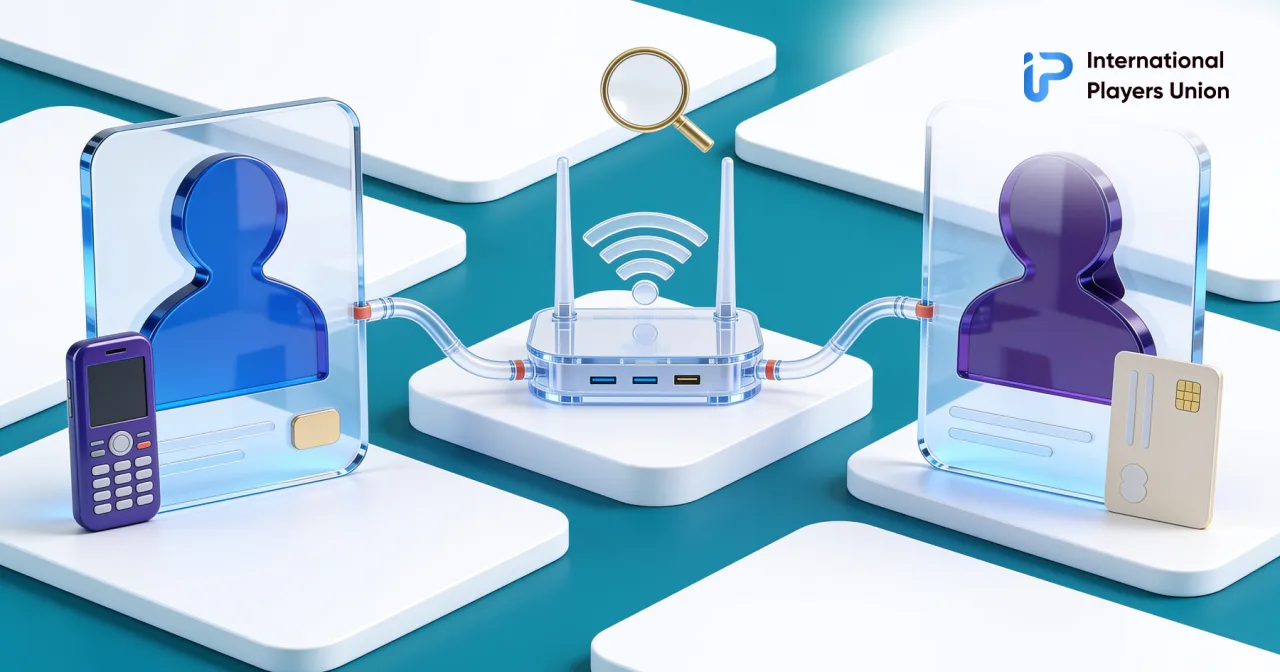
Shared Wi-Fi and One Device in the Family: How False Signs of Multi-Accounting Arise
Shared Wi-Fi, an address or a device can link several accounts in a verification system, but such a link alone does not prove that one person created several accounts. The operator may compare network, registration, payment and gaming data and ask for an explanation. The exact algorithms, and whether several players from one household are allowed, depend on its rules and licence.
The safest approach for adult family members: each person uses only their own account, real data, their own payment method and separate contact details. Do not share passwords, do not log in for each other and check in advance whether bonuses are limited per address or household. If a check starts, do not open a new account. Save the notice and the login history, and ask for the specific rule clause.
Why the system may see a link
A remote operator has to tell one customer from another, verify age and identity, prevent fraud and, for some games, detect collusion. To do this, it may assess several matches together.
Public sources confirm individual categories of signals. In its risk materials, the UK Gambling Commission suggests that operators consider shared IP addresses and VPNs as possible indicators for remote gambling. Another official risk review describes an example of linked accounts on one device and IP. These are examples of risk assessment, not a rule under which any shared Wi-Fi proves a breach.
A possible link may be built on a combination of:
- a shared IP address;
- one device;
- the same home address;
- matching contact details;
- one payment method or one payment owner;
- one person logging in to several accounts;
- similar activity that needs an extra check;
- several accounts taking part in the same promotion.
Not every operator discloses the full set of signals. Do not try to “separate” technical traces or get around the controls. The player's task is to show with genuine data that the accounts are independent.
A risk signal is not a proven breach
The official UKGC risk assessment guidance states plainly that a higher risk of money laundering does not in itself mean that a person is a criminal or is laundering money. By analogy, for an account an indicator should be a reason for a check, not a substitute for facts. This is an editorial conclusion, not a universal duty of every operator.
For British licences, LCCP 3.9.1 requires policies that make it possible to identify separate accounts of the same person and link them, if the operator allows more than one account. This shows an important distinction: a regulatory rule does not always set a simple “one address equals one account” ban. A specific contract may introduce its own restrictions.
What to check before a second family member registers
| Area of the rulesWhat to ask | |
| Accounts | Is each adult allowed a separate account? |
| Household | Is there a limit per address, family or shared IP? |
| Device | Can you log in from a shared computer or phone? |
| Payments | Must the method belong to the holder of that specific account? |
| Bonuses | How many participants in one promotion are allowed per address or household? |
| KYC | Which documents can confirm that the users are independent? |
| Games | Are there limits on taking part together in the same peer-to-peer game? |
Ask these questions before a deposit or a promotion. Save the support reply and the version of the Terms. A verbal promise from an agent without a ticket number is weaker than a written confirmation.
Basic hygiene for two legitimate accounts
Each adult user should:
- register in person;
- give their own name, date of birth, phone number and email;
- use only their own payment method, if the rules require the owner to match;
- complete KYC themselves;
- not share passwords or codes with anyone else;
- not manage another user's bets or withdrawals;
- not open an account to get around self-exclusion, a limit or a block;
- check the household rules for promotions.
Living together does not make handing over an account safe. The UK Gambling Commission warns against giving your details to a third party to open a gambling account. This can be used to get around age checks, self-exclusion or restrictions, or to obtain extra promotions.
What IPU.bet says
The current IPU.bet Terms of Use allow each user only one account on the platform itself and prohibit transferring or sharing an account. This applies to the IPU.bet account.
A partner operator applies its own Terms. You cannot carry a partner's rule over to IPU.bet or the other way round. If two family members use both the platform and a partner, check both contracts separately.
If the account has already been restricted
Do not open a new account and do not ask a relative to withdraw funds for you. That adds new links and may break the rules.
Do the following:
- save the text of the notice and the account status;
- record the date, time, device and network of your recent logins;
- save the list of your payment methods and your transaction history;
- ask for the specific clause of the Terms and the type of link that needs explaining;
- ask which documents are needed and which data may be masked;
- prepare a separate timeline for each account;
- ask for confirmation that the documents were received and for a complaint number.
Do not send another adult's documents without their consent and an official request. Where possible, each user replies from their own verified channel.
How to explain shared Wi-Fi
A short explanation works better than a long emotional story:
Two adult users with separate accounts live in this household: [ID 1] and [ID 2]. We use a shared home internet connection, but we registered independently, use our own contact and payment details and do not give each other access. Please state the specific match and the rule clause being checked, and list in one place the documents needed to confirm that the accounts are independent.
Add only true facts. If the device really was shared, do not deny it. State the period, the reason and who logged in. False precision makes your account harder to verify.
Which documents can help
The set depends on the request. The operator may ask for proof of identity, proof of address, proof that you own the payment method or your login history. Before sending anything, ask:
- what exactly the document confirms;
- what period it should cover;
- which fields are required;
- which data may be masked;
- which secure channel to use;
- how long the file will be stored.
Do not send a password, CVV, one-time code, seed phrase or access to your bank. Do not upload materials through an open link “for everyone”.
How IPU.bet can help
Player Support can help you separate the accounts in a timeline, word a question about the specific match and put together an anonymised package. IPU.bet does not decide on a partner's account and does not guarantee that a restriction will be lifted.
If the IPU.bet account itself is being checked, the platform's current Terms apply. If a partner runs the check, the request and the documents must follow its procedure and licence.
Key points to remember
Shared Wi-Fi or a shared device can be part of a risk check, but they cannot automatically be treated as the full picture. Identity, control of the account, payments, promotion rules and actual activity all matter.
Separate accounts and data in advance. During a check, do not open a new profile, do not hide the shared network, and ask for the specific rule clause, the list of documents and a written decision.
18+. Play responsibly. Gambling is not a way to make money.
Prepare two separate timelines and one short explanation of the shared network. If you need help with the package, open the IPU.bet request form.
FAQ
Does shared Wi-Fi on its own prove multi-accounting?
No. A shared IP address, home address or device can link accounts in a verification system and become a reason to ask for an explanation, but on their own they do not prove that one person created several accounts. The exact algorithms and rules depend on the operator and its licence.
Can two family members have separate accounts with the same operator?
That depends on the operator's rules and licence. Before registering, check whether each adult is allowed a separate account, whether there are limits per address, shared IP or device, and how many participants in one promotion are allowed per household. Save the written support reply and the version of the Terms.
What should I do if my account was restricted because of a link to another account?
Do not open a new account and do not ask a relative to withdraw funds for you. Save the notice, the login history and the list of payment methods and transactions, ask for the specific clause of the Terms and the type of link, check which documents are needed and ask for a complaint number.
How do I explain a shared home network to the operator?
Briefly and truthfully: give the IDs of both accounts and state that the users are adults, registered independently, use their own contact and payment details and do not give each other access. If the device was shared, do not deny it; state the period, the reason and who logged in.
Which rules apply to an IPU.bet account?
The current IPU.bet Terms of Use allow each user only one account on the platform and prohibit transferring or sharing an account. A partner operator has its own Terms, so both contracts need to be checked separately. IPU.bet does not decide on a partner's account and does not guarantee that a restriction will be lifted.