
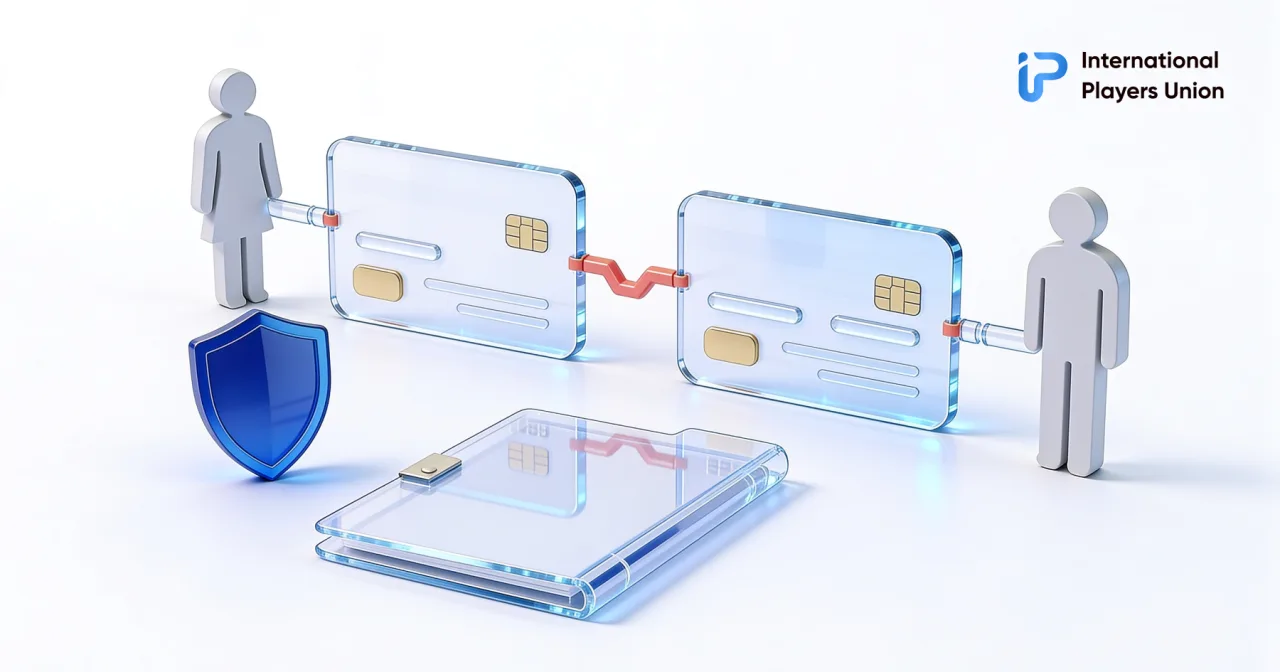
Depositing with Someone Else's Card or Wallet: Why It Puts Your Account at Risk of Being Blocked
Funding a gaming account with another person's card, bank account or wallet can lead to an extra check, a rejected payment, an account restriction or a dispute at withdrawal. The reason is simple: the name of the account holder, the source of the money and the recipient of a future payout no longer clearly match. What the operator actually does depends on its rules, its licence and the circumstances. A block is not automatic or universal, but the risk rises noticeably.
If you have not deposited yet, use only your own payment method that the rules allow. If the money is already in, do not open a second account, do not fake the cardholder's consent and do not add new payments to “fix” the situation. Save the receipt, the status, the rules and the correspondence, then tell the operator the facts in writing and ask for the official next steps.
What counts as a third-party payment
A third-party payment method can be:
- a card belonging to a spouse, relative, friend or colleague;
- a shared family account, if the rules do not accept it;
- an e-wallet registered in another name;
- a corporate card or company account;
- someone else's crypto wallet, if the operator checks the owner and the origin of funds;
- an intermediary who takes money and then tops up the gaming account;
- a payment service account that another person actually has access to.
Phrases like “we live together” or “the owner said it was fine” do not replace the operator's rules or the payment check. A joint account should not be treated as automatically allowed or automatically banned either: ask how both holders are verified.
Why the risk arises
Identity mismatch
The operator verifies the holder of the gaming account. For British licensees, LCCP 17.1.1 requires at least the name, address and date of birth to be established before the customer is allowed to gamble. If a payment comes from another name, the operator may need to understand who controls the account and whose money is being used.
Unclear source and purpose of funds
FATF Recommendation 10 provides for risk-based checks of the customer and transactions, including the source of funds where necessary. It is an international standard for countries to implement, not a single direct rule for every player.
In its risk assessment, the UK Gambling Commission lists payments from a spouse's card and payouts to a third party as examples of third-party payment and expects British operators to identify customers and check the source of funds. In another GEO, look at its own law and regulator.
Broken payment loop
The UKGC treats the closed-loop approach as best practice: a withdrawal goes back to the same method used for the deposit. With someone else's method there is a conflict: a refund to the original method goes to another person, while a payout to the player changes where the money flows.
Risk of bypassing restrictions
The UKGC specifically warns against handing personal data and bank accounts to third parties to open gaming accounts. Such schemes can be used to get around self-exclusion, age checks or limits, or for fraud. This does not mean that every family mistake has a criminal purpose, but it explains why the operator cannot rely on verbal consent alone.
What to check before you deposit
| QuestionWhere to lookSafe outcome | ||
| Whose name must be on the method | Payments, KYC, AML | the method belongs to the account holder or an exception is expressly allowed |
| Is a joint account acceptable | the rules and a written reply | you know what proof both holders must provide |
| Where the withdrawal will go | Withdrawals | the route matches the rules and the holder |
| Which methods are banned | the list of payment methods | you have chosen a method available in your GEO |
| When the method needs KYC | Verification | documents and fields are known in advance |
| What happens after a mistake | Complaints, Refunds | there is an official process, not advice from a chat |
Do not test whether a method is allowed with a small “trial” payment. A successful deposit on its own does not prove that withdrawals to that method are permitted.
If a third-party payment has already been made
1. Stop new transactions
Do not top up again and do not move money between accounts. Do not keep playing if that could change the disputed balance or make a refund harder.
2. Record the facts
Save:
- the deposit ID;
- the date, time, amount and currency;
- the last four digits of the card or the wallet ID;
- the method owner's name, without publishing full details;
- the status in your account;
- the receipt or statement;
- the rules as of the payment date;
- all correspondence.
3. Tell the operator the truth
Do not call the method yours if it belongs to someone else. Do not edit the statement and do not ask the cardholder to create a fake document. Write:
A deposit of [date, amount, currency] was made to account [ID] from a payment method owned by [their relationship to me, no unnecessary details]. Please state the applicable rule, the status of the funds, the full list of required proof and the permitted next steps. I am not making any further transactions related to this payment.
4. Clarify the role of the method owner
Ask the operator to state in writing whether a statement from the owner, a refund to the original method or another process is required. Do not send a third party's passport without a clear reason and a secure channel.
5. Keep the decision
Ask for a ticket number, the rule clause applied and a final reasoned reply. If the funds are refunded, save the transaction ID and status. If the account is restricted, ask which features are unavailable and what is needed for a review.
What not to do
- do not open a second account in the cardholder's name;
- do not change your profile name to the payer's name;
- do not make a new deposit from your own card to get unblocked;
- do not present a gift or a loan as proof that the method is yours;
- do not forge a statement, receipt or consent;
- do not request a chargeback as a reflex against your own authorised payment;
- do not send your CVV, PIN, codes, password or full access to your bank;
- do not publish the payer's personal data.
Can a family member or a gift pay for you
Only if the current rules and the payment law of the country concerned expressly allow it. Even then, proof of the relationship, consent and source of funds may be required. Before transferring, get a written reply that covers your specific type of account and method.
Do not confuse three separate questions:
- The bank technically let the transaction through.
- The cardholder agrees.
- The operator allows this source and this withdrawal route.
A yes to the first two questions does not guarantee a yes to the third.
When to move to a complaint
A formal complaint is appropriate if the operator:
- does not tell you the status of the money;
- demands new payments;
- changes the reason for the restriction;
- asks for unrelated documents without explanation;
- does not confirm receipt of your materials;
- applies a rule that was not in the version you saved;
- refuses to give a final position and the next route.
The complaint should honestly state that the payment came from a third party. Ask not for a guaranteed payout but for a transparent decision: the applicable rule, the status of the funds, the evidence needed and the available review process.
How IPU.bet can help
IPU.bet is an information platform: it does not accept payments on behalf of casinos, does not hold gaming funds and does not decide a partner's KYC. Player Support can help you put together a timeline and a written request. The outcome of the check, a refund, an unblock or a payout is not guaranteed.
For an initial review, share anonymised statuses, rules and replies. Do not send full card details, another person's documents, passwords, CVV, PIN, one-time codes, a seed phrase or a private key.
Key points to remember
Someone else's card or wallet creates not only a technical conflict but an identity one. A successful deposit does not mean the method is allowed for withdrawals. Before paying, check the owner, the rules and the closed-loop route.
If the mistake has already happened, stop new transactions, report the facts honestly, keep the documents and get the process in writing. Do not try to “fix” the situation with a new account, a new deposit or a fake confirmation.
18+. Play responsibly. Gambling is not a way to make money.
Before any deposit, open the payment rules and make sure the method is in the account holder's name. If a third-party payment has already been made, put together an anonymised timeline and open the IPU.bet request form.
FAQ
Can I fund a casino account with my husband's, wife's or relative's card?
Only if the operator's current rules expressly allow it. Many rules require the payment method to belong to the account holder. Before transferring, get a written reply that covers your specific type of card or account.
Does a deposit from someone else's card mean an automatic block?
No. A block is neither automatic nor universal. The operator may request a check, reject the payment or restrict the account depending on its rules, licence and the circumstances, but the risk of such a decision is noticeably higher.
What should I do if a payment from someone else's card has already gone through?
Stop new transactions and save the deposit ID, receipt, status, rules and correspondence. Then tell the operator honestly who owns the method and ask for the applicable rule, the status of the funds and the full list of required proof.
Where will a withdrawal go if the deposit came from someone else's method?
The operator decides under its rules. With a closed-loop approach the withdrawal goes back to the method used for the deposit, so the refund may go to the cardholder. Ask for the route to be confirmed in writing before taking any further steps.
Can IPU.bet guarantee a refund or an unblock?
No. IPU.bet is an information platform and does not decide an operator's KYC. Player Support can help you put together a timeline and a written request, but the outcome of the check, a refund and a payout are not guaranteed.